How to Check if Content Was Written by AI: 5 Reliable Detection Methods (Free Tool Included)
Artificial intelligence has changed content creation forever.
Today, students use AI to draft essays, marketers generate blog posts in minutes, and businesses rely on AI-powered tools to create everything from emails to product descriptions. While these technologies save time, they have also introduced a new challenge:
How can you tell if content was written by a human or generated by AI?
This question matters more than ever. Teachers want to protect academic integrity. Publishers want original content. Businesses want authentic brand messaging. Website owners want content that demonstrates expertise and delivers value to readers.
A free AI detector can help confirm your review before you make a final judgment.
The problem is that modern AI tools such as ChatGPT, Gemini, Claude, and other large language models have become remarkably good at mimicking human writing. In many cases, AI-generated content is almost impossible to identify through casual reading alone.
That's why content reviewers increasingly combine human judgment with specialized content detection software.
If you're trying to determine whether a piece of text was generated by artificial intelligence, this guide will show you exactly what to look for, which mistakes to avoid, and how to analyze content more accurately using modern AI detection methods.
Quick Answer: How to Check if Content Was Written by AI
The most reliable way to check if content was written by AI is to combine manual review with an AI content detection tool. Look for signs such as repetitive phrasing, generic explanations, predictable sentence structures, and a lack of personal experience. Then verify your findings using an AI Content Detector that analyzes writing patterns and estimates the likelihood that the text was generated by artificial intelligence.
No detection method is perfect on its own, which is why combining human expertise with AI-powered analysis typically produces the most accurate results.
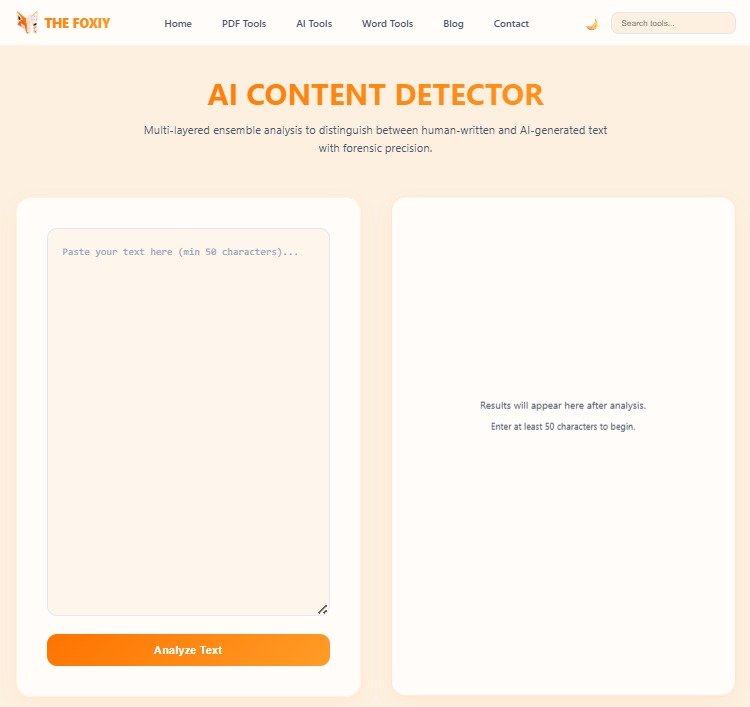
Example Interface of TheFoxiy AI Content Detector
Why AI Content Detection Matters More Than Ever
Just a few years ago, identifying AI-generated content was relatively easy.
Early AI systems often produced awkward sentences, repetitive wording, and unnatural phrasing. Most readers could quickly spot the difference between human writing and machine-generated text.
That is no longer the case.
Modern AI models are trained on massive datasets and can produce content that appears highly professional, informative, and well-structured. In many situations, readers cannot immediately tell whether a person or an AI system created the content.
As a result, AI detection has become increasingly important across multiple industries.
Education
Teachers and universities want to ensure students are demonstrating genuine understanding rather than submitting entirely AI-generated assignments.
Content Marketing
Businesses need content that reflects real expertise, industry knowledge, and brand authority rather than generic information found everywhere online.
Publishing
Editors and publishers often review submissions to maintain quality standards and ensure content meets editorial guidelines.
Search Engine Optimization
Search engines prioritize helpful, trustworthy content that demonstrates expertise and satisfies user intent.
The goal isn't necessarily to eliminate AI-generated content.
The goal is to understand how it was used and whether the final content provides real value to readers.
What Makes AI-Generated Content Different?
Before discussing detection methods, it's important to understand how AI writing systems work.
Large language models generate text by predicting the most likely sequence of words based on patterns learned from enormous datasets.
In simple terms, AI doesn't truly understand a topic the way humans do.
Instead, it predicts what words are most likely to come next.
This approach allows AI systems to create content that is:
- Grammatically correct
- Well-organized
- Easy to read
- Informative
However, because AI relies on prediction rather than genuine experience, certain patterns often emerge in its writing.
These patterns form the foundation of modern AI detection techniques.
5 Reliable Signs Content May Have Been Written by AI
No single indicator can prove that content was generated by artificial intelligence.
However, when several of these signs appear together, the likelihood of AI involvement increases significantly.
1. The Content Feels Generic
One of the most common characteristics of AI-generated content is a lack of specificity.
Consider these two examples:
Example A
"SEO is important because it helps businesses improve visibility online and attract more customers."
This statement is accurate, but it offers no unique insight.
Example B
"After improving page speed, fixing indexing issues, and publishing targeted content, our organic traffic increased by 37% within four months."
The second example contains:
- Real-world context
- Specific numbers
- Actionable insights
- Evidence of experience
Human writers naturally draw from projects, successes, failures, and observations.
AI systems often rely on broad summaries instead.
If content feels informative but never goes beyond surface-level explanations, AI assistance may have played a role.
2. The Writing Repeats Similar Patterns
During testing of AI-generated articles, one pattern appears consistently:
AI loves repetition.
This doesn't always mean repeating the exact same sentence.
Instead, AI often repeats:
- Similar sentence structures
- Similar paragraph formats
- Similar transitions
- Similar explanations
For example, many AI-generated articles repeatedly use phrases such as:
- Furthermore
- Moreover
- In addition
- It is important to note
- In conclusion
Occasional use is normal.
However, excessive repetition can indicate machine-generated writing patterns.
3. The Content Lacks Personal Experience
One of the strongest indicators of human writing is personal experience.
Experienced writers often include:
- Case studies
- Lessons learned
- Project results
- Industry observations
- Personal opinions
For example:
A teacher discussing years of grading assignments.
A marketer sharing campaign performance data.
A developer explaining challenges encountered while building software.
These types of insights are difficult for AI to reproduce authentically because they come from real-world experience rather than prediction.
When content contains no personal perspective whatsoever, it may warrant closer examination.
4. Every Paragraph Feels Too Perfect
Human writing naturally contains variation.
Some sentences are short.
Others are long and detailed.
Ideas flow differently depending on the topic and the writer's style.
AI-generated content often feels unusually consistent.
Paragraphs tend to have similar lengths.
Sentence structures follow predictable patterns.
Transitions appear at regular intervals.
This consistency may seem positive at first, but excessive uniformity can sometimes indicate AI involvement.
5. The Article Avoids Strong Opinions
Human experts develop opinions through experience.
They learn what works, what doesn't, and why.
AI-generated content often attempts to remain neutral at all times.
As a result, articles may:
- Avoid making recommendations
- Avoid taking positions
- Avoid discussing failures
- Avoid sharing lessons learned
This creates content that feels safe but often lacks genuine expertise.
When reviewing content, ask yourself:
Does the author sound like someone who has actually done this before?
If the answer is unclear, further analysis may be necessary.
Why Manual Detection Alone Often Fails
Many people assume they can identify AI-generated content simply by reading it.
Unfortunately, that approach is becoming less reliable every year.
Modern AI systems can generate content that appears highly natural.
At the same time, some human-written content can sound robotic, especially in academic, legal, or technical fields.
This creates two common problems:
False Positives
Human-written content is incorrectly identified as AI-generated.
False Negatives
AI-generated content is mistakenly assumed to be human-written.
Because of these limitations, manual review should be viewed as the starting point rather than the final verdict.
The most accurate approach combines human evaluation with specialized AI detection technology.
Manual Detection vs AI Detection Tools
While manual review can reveal obvious signs of AI-generated content, it becomes far less reliable when evaluating sophisticated AI writing.
Modern language models are capable of producing articles that are grammatically correct, logically structured, and highly readable. As a result, relying solely on instinct can lead to inaccurate conclusions.
An AI detection tool can provide a data-driven second opinion that complements your own review.
The most effective approach combines human judgment with automated AI detection technology.
| Feature | Manual Detection | TheFoxiy AI Content Detector |
|---|---|---|
| Speed | Slow and time-consuming | Instant analysis |
| Accuracy | Depends on reviewer experience | Data-driven assessment |
| Large Documents | Difficult to review thoroughly | Handles large content efficiently |
| Consistency | Varies between reviewers | Consistent evaluation |
| Scalability | Limited | Suitable for frequent use |
| Efficiency | Low for large workloads | High |
Manual review is still valuable because humans can evaluate context, expertise, and intent.
However, AI detection tools can identify statistical patterns that are impossible to recognize consistently through manual review alone.
How to Analyze Content Using TheFoxiy AI Content Detector
Instead of relying entirely on guesswork, you can use an AI Content Detector to evaluate writing patterns and estimate the likelihood that content was generated by artificial intelligence.
TheFoxiy AI Content Detector is designed to help users quickly review content and identify potential AI-generated writing.
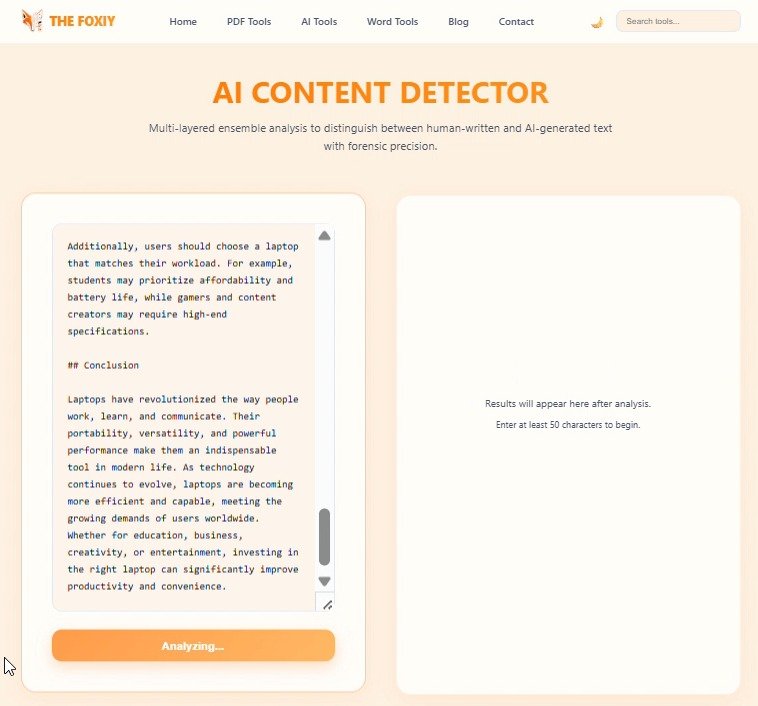
Analyzing Content Using TheFoxiy AI Content Detector
What an AI Detector Actually Looks For
Most people assume AI detectors simply compare text against a database.
In reality, modern AI detection systems use advanced statistical analysis to evaluate language patterns.
Several factors influence the final assessment.
Perplexity
Perplexity measures how predictable a piece of writing is.
AI systems generally choose highly probable words and phrases because they are designed to predict the most likely next word in a sequence.
Human writing is often less predictable.
People introduce unexpected examples, personal experiences, unique observations, and creative phrasing.
Lower perplexity often suggests more predictable language patterns, which can be associated with AI-generated content.
Burstiness
Burstiness measures variation in sentence structure and length.
Humans naturally write with uneven rhythms.
For example:
Short sentence.
Then a much longer sentence that contains multiple ideas, examples, and supporting details before returning to a shorter statement.
AI-generated content frequently displays more consistent sentence lengths and patterns.
While burstiness alone cannot determine authorship, it is an important signal used in many AI detection systems.
Probability Signals
Detection tools also analyze:
- Word selection patterns
- Language predictability
- Structural consistency
- Statistical relationships between phrases
These signals help estimate whether content resembles common AI-generated writing patterns.
Example Content Review Workflow
A practical AI detection workflow usually follows these steps:
Step 1
Read the content once without making assumptions.
Step 2
Look for common AI indicators such as:
- Generic explanations
- Repetitive transitions
- Lack of personal experience
Step 3
Analyze the content using an AI Content Detector.
Step 4
Compare the AI assessment with your own observations.
Step 5
Make a final decision based on both human judgment and automated analysis.
This process is widely used by publishers, educators, businesses, and content teams.
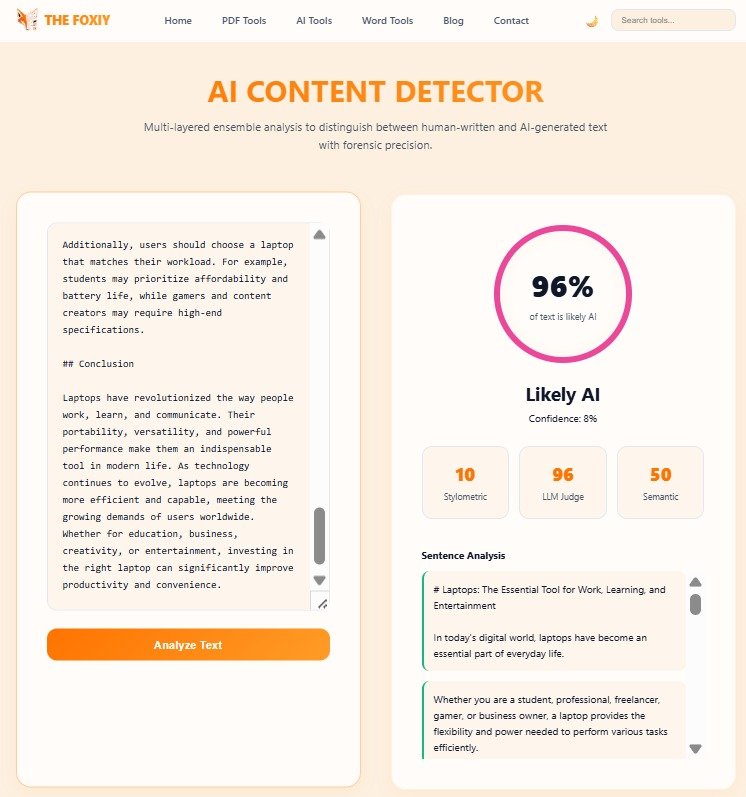
Example AI Detection Report Generated by TheFoxiy AI Content Detector
Can Google Detect AI Content?
One of the most common questions among website owners is:
Can Google detect AI-generated content?
The answer is more complex than a simple yes or no.
Google's primary focus is not whether content was written by AI.
Instead, Google's algorithms evaluate whether content is:
- Helpful
- Reliable
- Accurate
- Trustworthy
- Useful to readers
According to Google's guidance, content should demonstrate:
- Experience
- Expertise
- Authoritativeness
- Trustworthiness
Often referred to as E-E-A-T.
This means low-quality content can struggle to rank regardless of whether it was created by a human or an AI system.
Likewise, high-quality content that provides genuine value can perform well even if AI assisted in the writing process.
What Website Owners Should Focus On
Instead of asking:
"Can Google detect AI content?"
A better question is:
"Does this content genuinely help users?"
If the answer is yes, you're already aligned with Google's long-term goals.
Can Teachers Detect ChatGPT Essays?
Teachers are among the groups most affected by the rise of AI-generated content.
However, detecting AI-written assignments is not always straightforward.
Common Warning Signs
Teachers often notice:
- Sudden changes in writing quality
- Vocabulary that exceeds a student's typical level
- Generic explanations
- Lack of personal reflection
- Highly structured responses
For example:
If a student who normally struggles with writing suddenly submits an exceptionally polished essay, it may raise questions.
However, suspicion alone is not evidence.
Why Detection Is Difficult
Modern AI systems can generate highly convincing academic content.
As a result, many educators now combine:
- Classroom performance
- Writing history
- Instructor review
- AI detection software
Using multiple forms of evidence provides a more balanced and accurate assessment.
Important Limitation
No AI detector should be treated as absolute proof of misconduct.
Detection tools are best used as part of a broader review process rather than as a final verdict.
Real-World Applications of AI Detection
AI detection is no longer limited to schools and universities.
Today, organizations across multiple industries use AI detection tools to support content quality control.
Content Marketing
Review AI-assisted drafts before publication.
Publishing
Evaluate guest contributions and editorial submissions.
Recruitment
Assess application materials and written assessments.
Education
Support academic integrity initiatives.
Business Communication
Maintain quality standards for internal and external content.
As AI adoption continues to grow, content verification is becoming a standard part of modern workflows.
Common AI Detection Mistakes to Avoid
As AI-generated content becomes more sophisticated, many people make incorrect assumptions when evaluating text. These mistakes often lead to false conclusions and unreliable assessments.
Understanding these common errors can help you evaluate content more accurately.
Mistake #1: Assuming Good Writing Means AI
One of the biggest misconceptions is that polished writing automatically indicates AI usage.
Professional writers, marketers, journalists, and subject-matter experts often produce highly structured content with excellent grammar and readability.
Strong writing alone is not evidence of AI generation.
Always evaluate multiple factors before reaching a conclusion.
Mistake #2: Treating AI Detector Scores as Absolute Proof
AI detection tools provide probability-based assessments.
They do not provide certainty.
For example, a detector might indicate that content is likely AI-generated, but that result should be considered alongside:
- Writing context
- Author background
- Supporting evidence
- Manual review
The best approach combines technology with human judgment.
Mistake #3: Ignoring Real-World Context
Context matters.
A technical whitepaper, research paper, or legal document will naturally sound different from a personal blog post.
Content should always be evaluated based on its purpose and audience.
Ignoring context can lead to inaccurate conclusions.
Mistake #4: Looking for Only One Signal
No single indicator can reliably prove AI authorship.
For example:
- Repetition alone is not enough.
- Formal language alone is not enough.
- Consistent sentence structure alone is not enough.
Reliable detection requires multiple signals working together.
Mistake #5: Forgetting That Humans Also Use AI
Many professionals use AI tools to:
- Generate ideas
- Create outlines
- Improve grammar
- Accelerate research
As a result, content often exists on a spectrum between fully human-written and fully AI-generated.
The most important question is not whether AI was involved.
The most important question is:
Does the content provide genuine value to readers?
Frequently Asked Questions
How can I check if content was written by AI?
The most effective method is combining manual review with an AI content detector. Look for generic language, repetitive patterns, lack of personal experience, and then verify your findings using AI detection software.
Can AI-generated content be detected accurately?
AI detection tools can identify many common AI writing patterns, but no tool can guarantee perfect accuracy. Results should always be interpreted carefully.
Can ChatGPT content be detected?
In many cases, yes. Modern AI detectors can identify characteristics commonly associated with ChatGPT-generated content. However, heavily edited content becomes more difficult to detect accurately.
What is perplexity in AI detection?
Perplexity measures how predictable writing is. AI-generated content often uses highly predictable language patterns, while human writing tends to be more varied and unpredictable. Many AI detection systems use perplexity as one of several evaluation signals.
What is burstiness in AI detection?
Burstiness measures variation in sentence length and structure. Human writers naturally alternate between short and long sentences, while AI-generated content often follows more consistent patterns.
Are AI content detectors 100% accurate?
No. All AI detection tools have limitations and can occasionally produce false positives or false negatives. They should be used as part of a broader content review process.
Can teachers detect ChatGPT essays?
Teachers may identify AI-generated assignments through changes in writing style, vocabulary, classroom performance, and AI detection software. Most institutions use multiple forms of evidence rather than relying on a single detection tool.
Does Google penalize AI-generated content?
Google focuses on content quality rather than content creation methods. Helpful, trustworthy, and useful content can perform well regardless of whether AI assisted in the writing process.
Final Thoughts
Artificial intelligence has fundamentally changed the way content is created.
While AI tools can increase productivity and accelerate content creation, they also make it more difficult to determine who—or what—wrote a piece of text.
The good news is that reliable detection methods exist.
By combining:
- Manual review
- AI detection tools
- Context analysis
- Human expertise
you can make significantly more informed decisions about content authenticity.
Remember that no single method provides perfect accuracy.
The goal is not to prove authorship with absolute certainty.
The goal is to evaluate quality, authenticity, and trustworthiness as effectively as possible.
As AI continues to evolve, understanding how AI detection works will become an increasingly valuable skill for educators, publishers, marketers, businesses, and website owners alike.
If you need to humanize AI-generated text or make AI content sound human, you can also use the AI Humanizer to improve AI-generated writing.
Try TheFoxiy AI Content Detector
If you want a faster and more reliable way to evaluate content, try TheFoxiy AI Content Detector.
Whether you're reviewing assignments, blog posts, marketing copy, or business content, the tool can help you identify patterns commonly associated with AI-generated writing.
Use it to:
- Analyze content within seconds
- Review AI probability signals
- Improve content quality workflows
- Support publishing decisions
- Save valuable review time
Try TheFoxiy AI Content Detector
If you want a faster and more reliable way to evaluate content, try TheFoxiy AI Content Detector.
Whether you're reviewing assignments, blog posts, marketing copy, or business content, the tool can help you identify patterns commonly associated with AI-generated writing.